Early 1700s – 1800s ( Extinct in 1952)
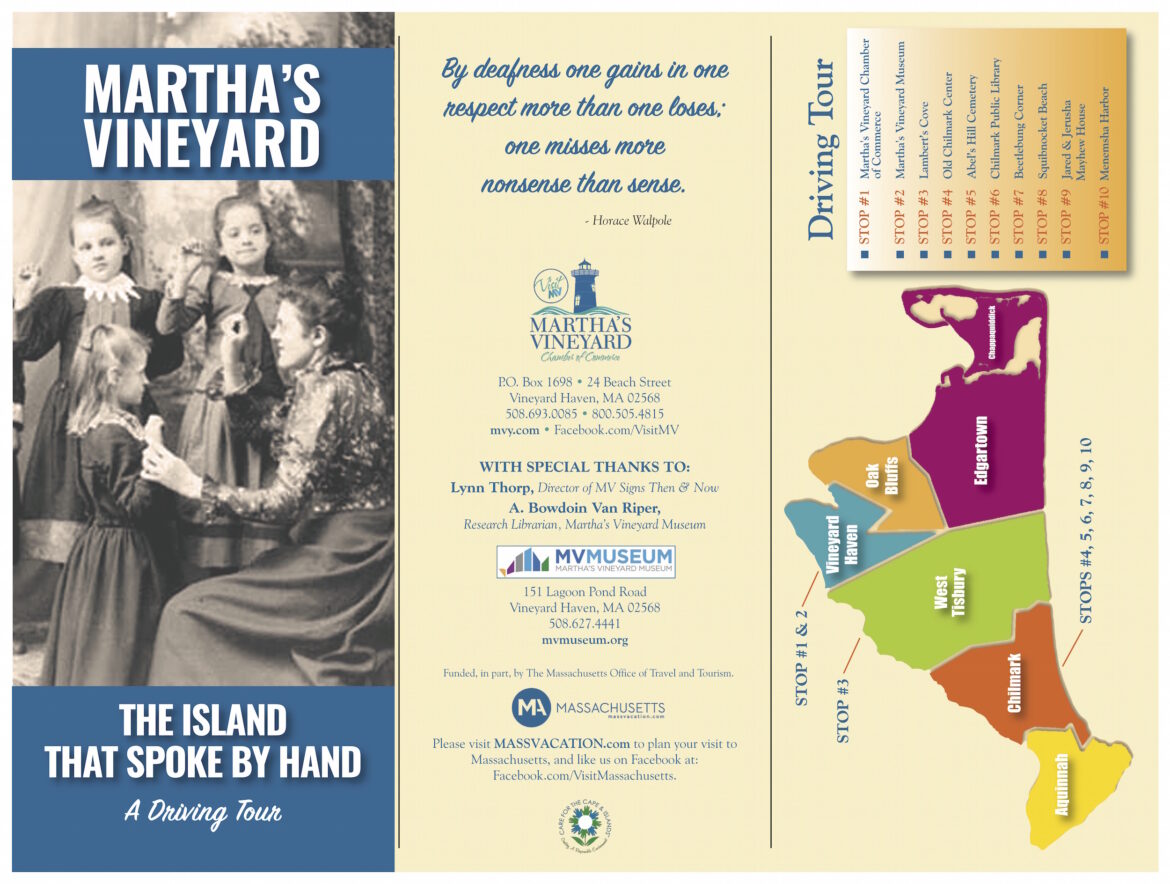
Chilmark – Martha’s Vinyard Sign Language
Martha’s Vineyard Sign Language (MVSL) was a village sign-language that was once widely used on the island of Martha’s Vineyard, United States, from the early 18th century to 1952. It was used by both deaf and hearing people in the community; consequently, deafness was not a barrier to participation in public life. Deaf people who signed Martha’s Vineyard Sign Language were extremely independent.
In 1854, when the island’s deaf population peaked, an average of one person in 155 was deaf, while the United States national average was one in about 5,730. In the town of Chilmark, which had the highest concentration of deaf people on the island, the average was 1 in 25; at one point, in a section of Chilmark called Squibnocket, as much as 1 in 4 of the population of 60 was deaf.
Hereditary deafness had appeared on Martha’s Vineyard by 1714. The ancestry of most of the deaf population of Martha’s Vineyard can be traced to Kent in the south of England. Martha’s Vineyard Sign Language (MVSL) may be descended from a hypothesized sign language of that area in the 16th century, now referred to as Old Kent Sign Language. Families from a Puritan community in the Kentish Weald emigrated to the Massachusetts Bay Colony in British America in the early 17th century, and many of their descendants later settled on Martha’s Vineyard. The first deaf person known to have settled there was Jonathan Lambert, a carpenter and farmer, who moved there with his wife—who was not deaf—in 1694.
In 1825, three young Chilmark women boarded a boat for a long journey to inland Connecticut. The journey would make them the first residents of the Vineyard to attend the new American School for the Deaf, located in Hartford, Conn.
Sign language on the island declined when the population migrated to the mainland. There are no fluent signers of MVSL today. Katie West, the last deaf person born into the island’s sign-language tradition, died in 1952
May 25, 1814
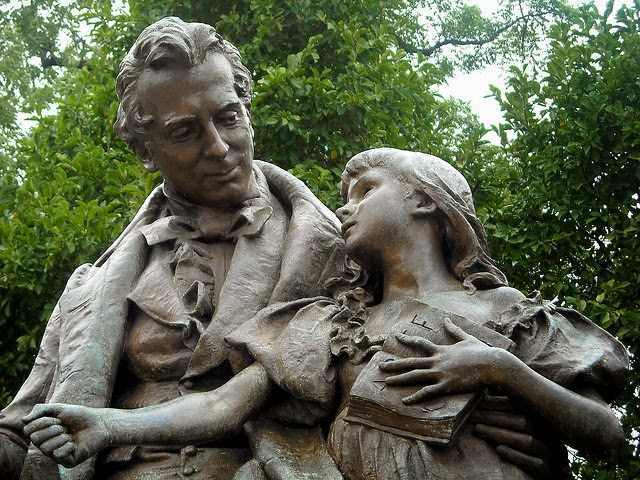
Thomas Hopkins Gallaudet meets Alice Cogswell
Thomas Gallaudet met Alice Cogswell the nine-year-old deaf daughter of a neighbor, Dr. Mason Cogswell. As he observed Alice playing apart from other children, he wanted to teach her. Gallaudet started to teach Alice what different objects were called by writing their names and drawing pictures of them with a stick in the dirt. Dr. Cogswell was impressed and invited Gallaudet to continue teaching Alice through the summer.
In 1815 Dr. Cogswell, with several businessmen and clergy, asked Gallaudet to travel to Europe to study methods for teaching deaf students, especially those of the Braidwood family in Scotland. Gallaudet found the Braidwoods unwilling to share knowledge of their oral communication method. He also was not satisfied the oral method produced desirable results.
While still in the United Kingdom, he met Abbé Sicard, head of the Institution Nationale des Sourds-Muets à Paris, and two of its deaf faculty members, Laurent Clerc and Jean Massieu. Sicard invited Gallaudet to Paris to study the school’s method of teaching the deaf using manual communication. Impressed with the manual method, Gallaudet studied teaching methodology under Sicard, learning sign language from Massieu and Clerc, who were both highly educated graduates of the school.
Having persuaded Clerc to accompany him, Gallaudet sailed back to America. The two men, with the help of Dr. Cogswell, toured New England and successfully raised private and public funds to fund a school for deaf students in Hartford, which later became known as the American School for the Deaf (ASD), in 1817. Young Alice was one of the first seven students at ASD.
1815
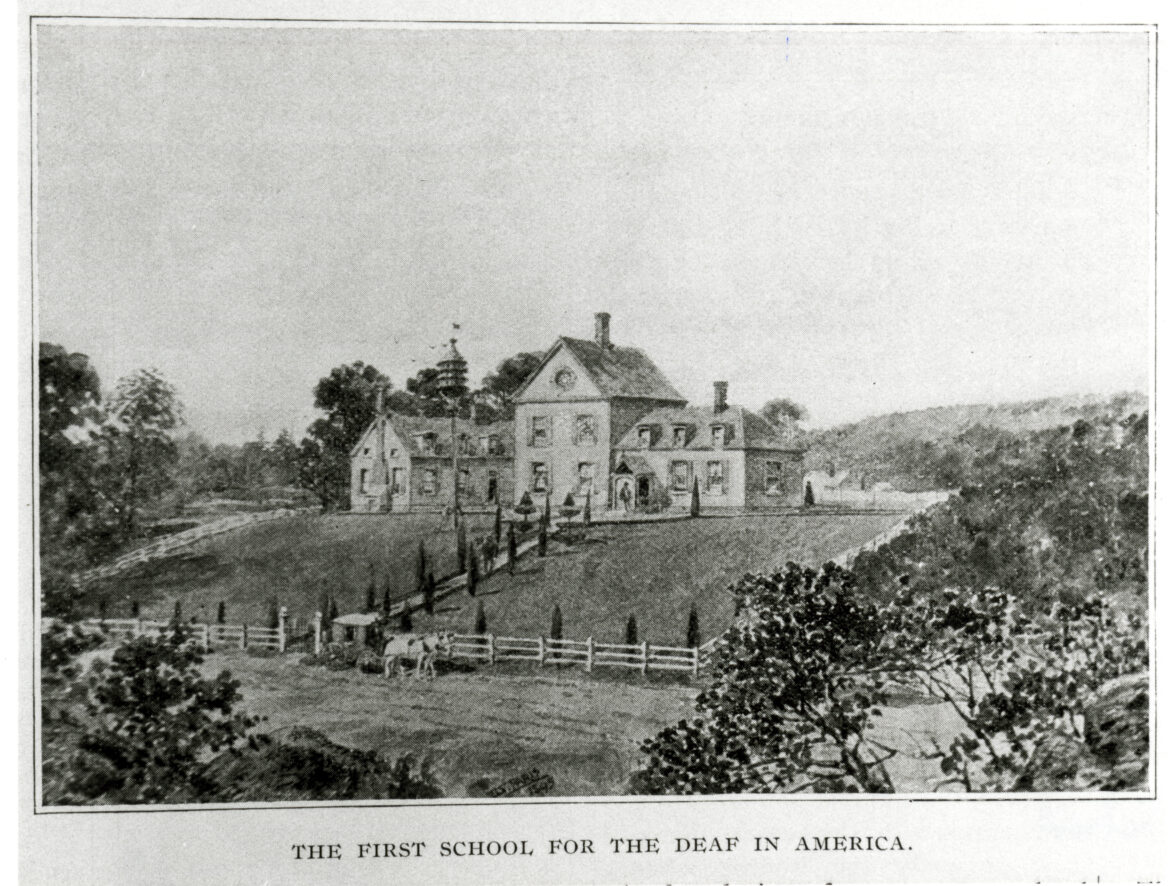
Cobbs School of Virginia – First Deaf School in America
William Bolling met John Braidwood, a descendant of Thomas Braidwood after he arrived in America in 1812, William Bolling invited him to stay in his home where he tutored Bolling’s children until Braidwood sorted out a more permanent living arrangement. After many setbacks, the Cobbs School (oral) was established in 1815 with John Braidwood as a teacher. It closed about a year and a half later, in the fall of 1816, when Braidwood’s personal problems caused him to leave the school and Bolling could no longer financially maintain it.
April 15, 1817
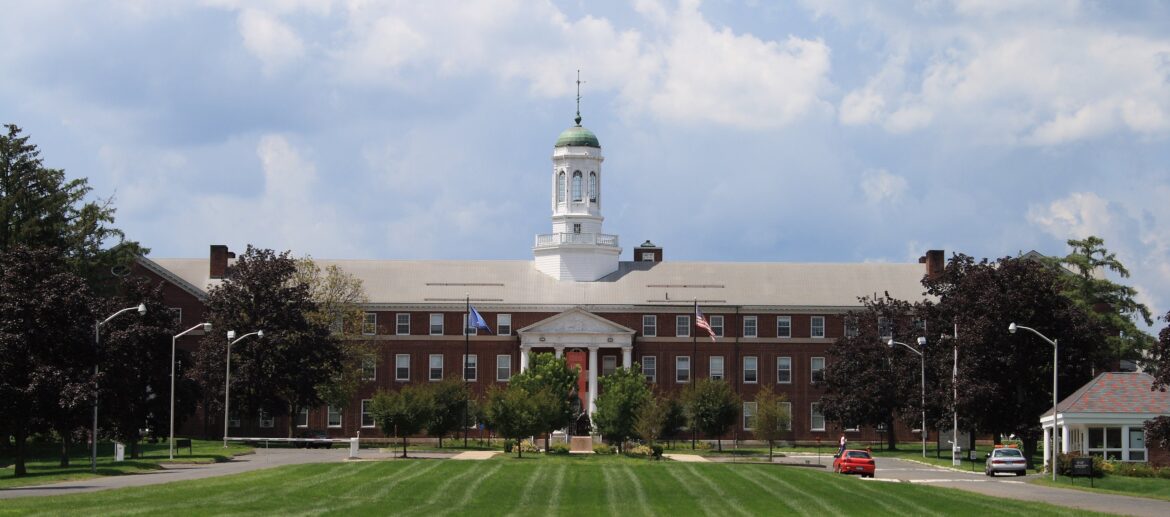
The American Asylum, At Hartford, For The Education And Instruction Of The Deaf Opens
The American School for the Deaf (ASD), originally The American Asylum, At Hartford, For The Education And Instruction Of The Deaf, is the oldest permanent school for the deaf in the United States, and the first school for deaf children anywhere in the western hemisphere. It was founded April 15, 1817, in Hartford, Connecticut, by Thomas Hopkins Gallaudet, Mason Cogswell, and Laurent Clerc and became a state-supported school later that year.
The American School for the Deaf was also one of the first deaf schools in the country to admit African American students, beginning in 1825. Charles Hiller, a 15-year-old from Nantucket, enrolled in 1825 and graduated in 1829. At least a dozen more African American children attended ASD throughout the 19th century.
1800s
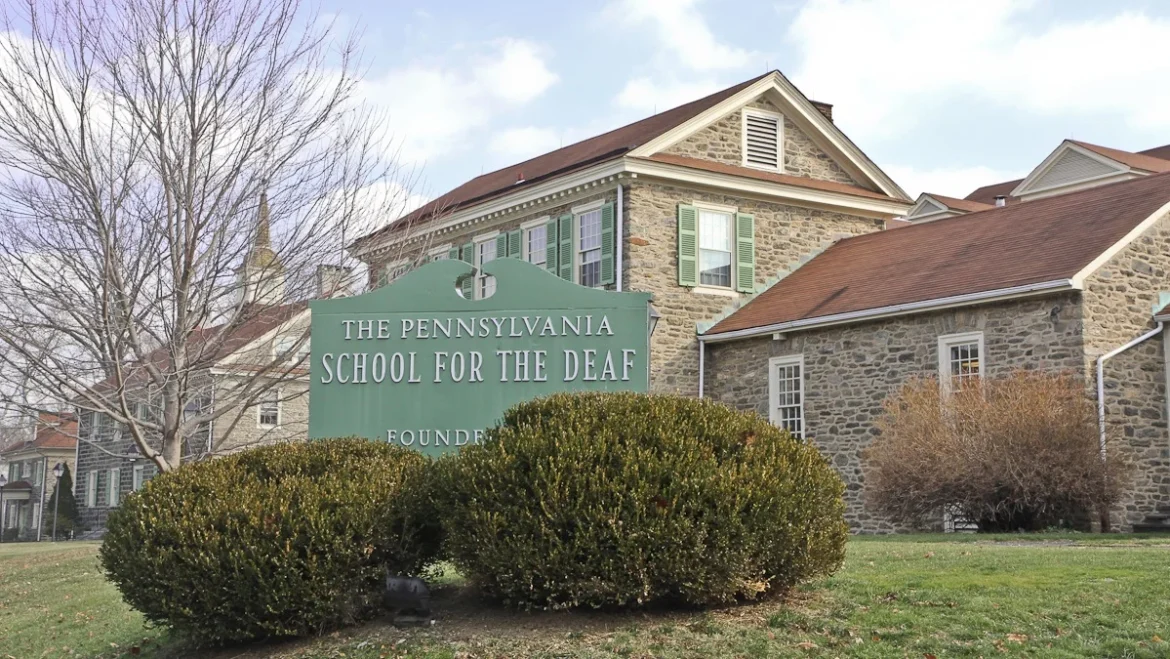
Other Deaf Schools Are Founded
1818: The New York School for the Deaf is established.
1820: The Pennsylvania School for the Deaf is founded.
1823: The Kentucky School for the Deaf opens, the first to be supported by a state.
1827: The Ohio School for the Deaf is established.
1839: The Virginia School for the Deaf is founded.
1864
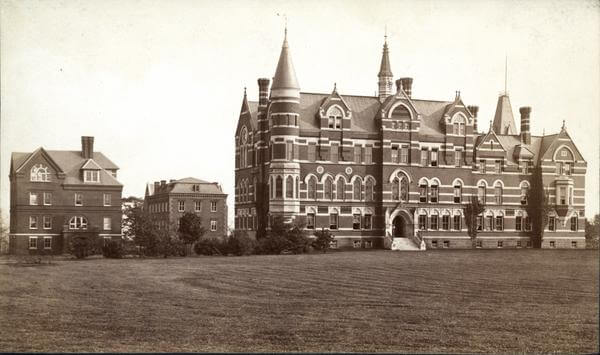
Gallaudet College is Founded
In 1857, Amos Kendall donated land for the establishment of a school for the deaf and blind in Washington, D.C., and asked Edward Miner Gallaudet (Son of Thomas Gallaudet) to come to Washington to help lead this school. Edward agreed and became the first principal of the Columbia Institution for the Deaf.
In 1864, Gallaudet sought college status for the Columbia Institution and got it when President Abraham Lincoln signed a bill into law which authorized the Columbia Institution to confer college degrees. This first college of the deaf eventually became Gallaudet University.
Gallaudet was the president of Gallaudet College/Columbia for 46 years (1864–1910), was the head administrator for 53 years (1857–1910), and was the president of the board of directors for 47 years (1864–1911).
He was a staunch advocate of sign language. He recognized the value of speech training, but also recognized that speech training was not for everyone. Although he initially preferred manualism, stating that sign language was the “natural language of deaf people”, throughout his life he came to believe that students should be educated using whichever method fit their specific needs—which could include speech training. He concluded, “no one method is suited to the conditions of all the deaf”. Still, he sometimes referred to oralism as the “artificial method” and deemed that it was only a “partial success”.
1860s

Deaf Schools for Black Children open
Deaf schools for black children opened in the 1860s. The segregation of early residential schools and then the segregation in dorms and classrooms later led to two sign languages in America–American Sign Language and Black American Sign Language. Both have tremendous cultural significance and identity. Gallaudet University did not admit Black Deaf students until 1950.
1872
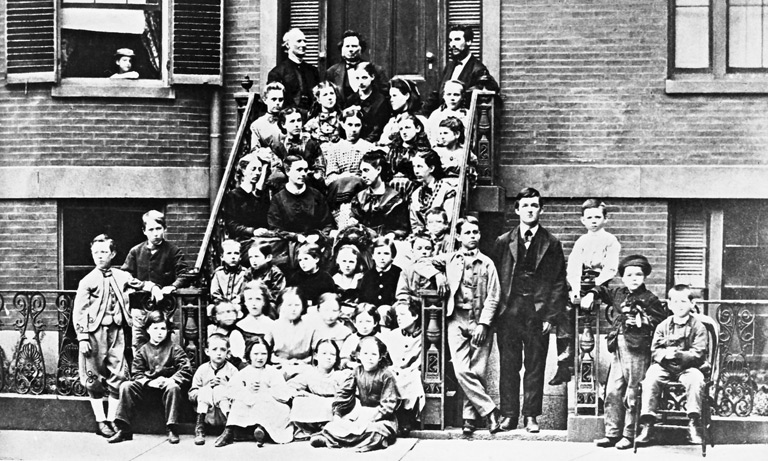
Alexander Graham Bell Founds Oralist School
During his lifetime, Alexander Graham Bell widely promoted both eugenics and oralism, the belief that Deaf individuals should be taught speech and lip-reading over sign language. AGB actively worked to pass laws to prevent intermarriage within the Deaf community in a desire to eradicate deafness, and he worked to close thriving residential schools for the Deaf and to eradicate the use of American Sign Language.
His work and that of those who joined him caused a great deal of harm to the Deaf community. Both Bell’s mother and wife were deaf, but Bell’s wife did not use sign language and did not want people to know she was was deaf. His father, Melville Bell, created ‘Visible Speech,’ a system of symbols meant to assist people in speaking languages they could not hear, and in 1872, Alexander Graham Bell was invited to the Clarke School to present on Visible Speech.
Soon after, he returned to Massachusetts to open his own private school for the Deaf in Boston. Later, Bell abandoned the Visible Speech method but maintained his insistence that Deaf individuals needed to learn to speak in order to be professionally and socially integrated. Eventually, Bell’s name became synonymous with oralism in the Deaf community.
1880
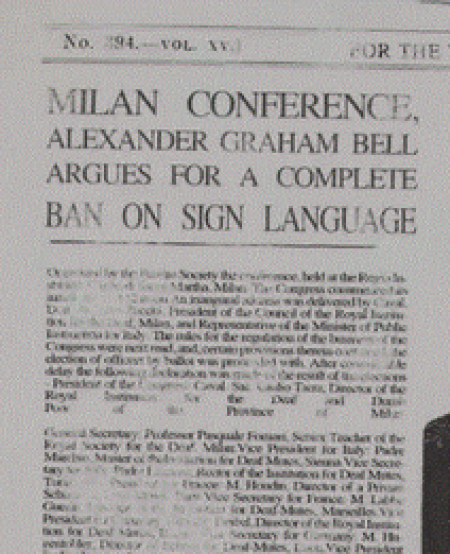
Second International Congress on Education of the Deaf
The Second International Congress on Education of the Deaf was an international conference of deaf educators held in Milan, Italy in 1880. It is commonly known as the “Milan Conference” or “Milan Congress”.
After deliberations from 6 to 11 September 1880, the Milan Conference declared that oral education (oralism) was superior to manual education (sign language) and passed a resolution banning the use of sign language in school. After its passage, various European and American schools largely switched to using speech therapy without sign language as a method of deaf education until the late 1960s and early 1970s, when sign language started to be recognised as the ideal method of deaf education.
First repudiation 1980 – 24th ICED Hamburg Germany
At the 15th International Congress on the Education of the Deaf (ICED) held in Hamburg, in then-West Germany in 1980, the first major step in repudiating the 1880 resolutions was set by a large group of attendees who, in an informal consensus, rejected the 1880 resolutions in practical and moral terms in deciding that the 1880 resolutions had no longer any appropriate standing.
2010 – 21st ICED Vancouver, BC, Canada
A formal apology was made by the board at the 21st International Congress on Education of the Deaf in Vancouver, BC, Canada, acknowledging the detrimental effects of such a ban as an act of discrimination and violation of both human and constitutional rights.
2025 – 24th ICED Rome, Italy
The resolution that was passed in the conference of 1880 was “fully and unequivocally” renounced during the 24th International Congress on Education of the Deaf. Among the reasons given for the renunciation are the “profound and long-lasting harm caused by those resolutions, including the widespread exclusion of sign languages from educational systems and the systematic language deprivation experienced by generations of deaf children” and the acknowledgment that “these measures suppressed a natural human linguistic modality and severely restricted the ability of deaf individuals to fully exercise their human rights”.
1880

National Association of the Deaf Founded
The National Association of the Deaf (NAD) is the nation’s premier civil rights organization of, by and for deaf and hard of hearing individuals in the United States of America. Established in 1880, the NAD was shaped by deaf leaders who believed in the right of the American deaf community to use sign language, to congregate on issues important to them, and to have its interests represented at the national level. These beliefs remain true to this day, with American Sign Language as a core value.
1960
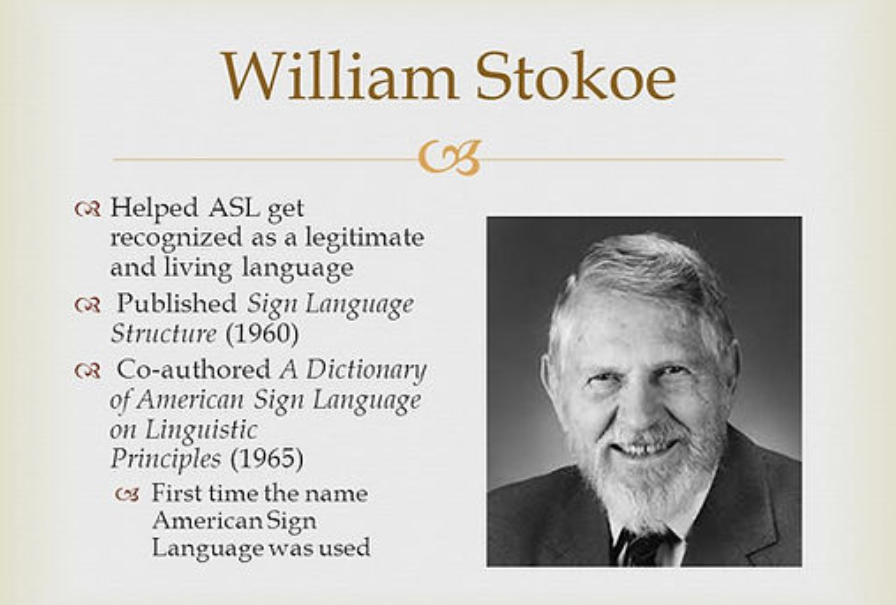
Stokoe publishes findings on sign language being a legit language
Stokoe published his findings about sign language as a legit language. His publication did not attract much attention until it is republished in 1965 with Casterline and Croneberg as Dictionary of ASL on Linguistic Principles.
His publication leads to the return of ASL to Deaf schools. The Deaf community had been denied their native and natural language for decades due to the work of Alexander Graham Bell. Deaf children who signed sometimes experienced abuse, including having hands tied to chairs, hands struck, being forced to kneel on broomsticks, etc. Painful tools were used in and on the mouth to teach speech.