Enacted September 26, 1973
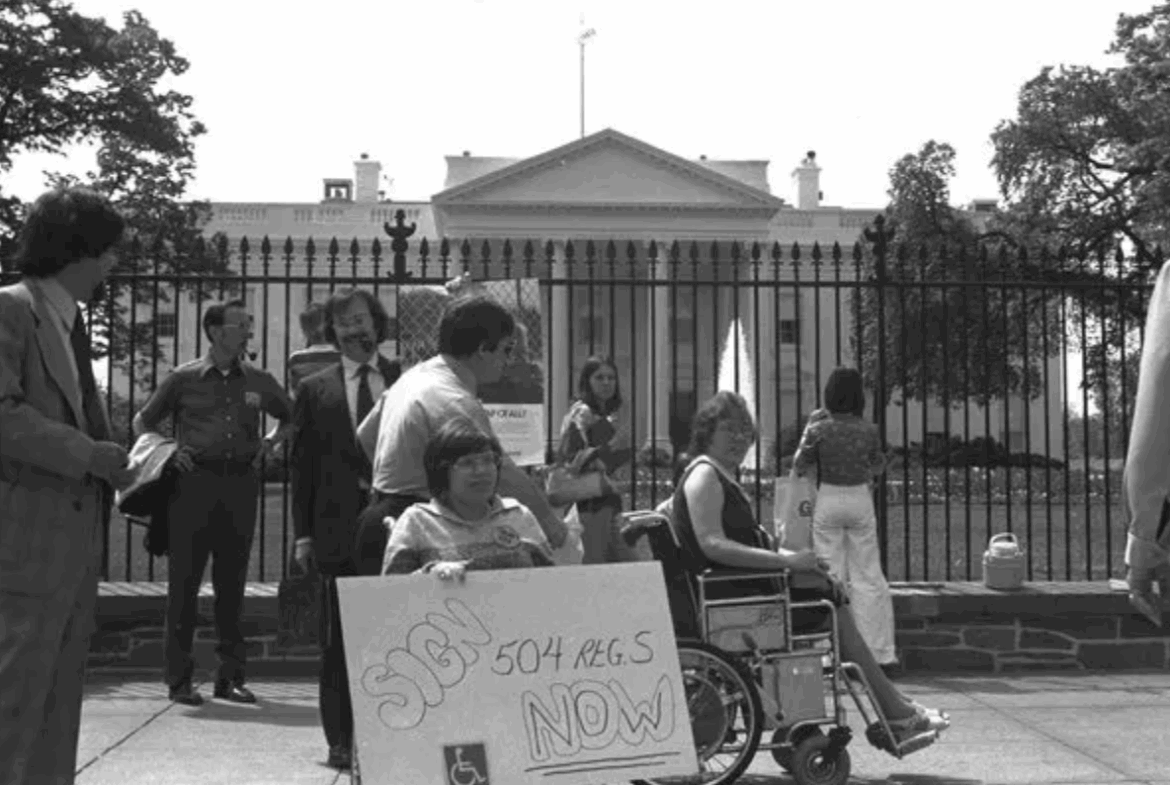
Rehabilitation Act of 1973
The Rehabilitation Act of 1973 is a federal law prohibiting discrimination against people with disabilities. It prohibits discrimination in federally funded programs and activities (Section 504), requires federal contractors to take affirmative action to employ individuals with disabilities (Section 503), and mandates federal government agencies to provide equal opportunities and accessible information technology for individuals with disabilities (Sections 501 and 508). The act also established programs for independent living services and vocational rehabilitation.
Section 501
Section 501 requires affirmative action and nondiscrimination in employment by Federal agencies of the executive branch. To obtain more information or to file a complaint, employees must contact their agency’s Equal Employment Opportunity Office.
Section 503
Section 503 requires affirmative action and prohibits employment discrimination by Federal government contractors and subcontractors with contracts of more than $10,000.
Section 504
Section 504 created and extended civil rights to people with disabilities. Section 504 has also provided opportunities for children and adults with disabilities in education, employment, and various other settings. It even allows for reasonable accommodations such as special study area and assistance as necessary for each student.
Section 505
Section 505 contains provisions governing remedies and attorney’s fees under Section 501.
Section 508
Section 508 establishes requirements for electronic and information technology developed, maintained, procured, or used by the Federal government. Section 508 requires Federal electronic and information technology to be accessible to people with disabilities, including employees and members of the public.
Signed into law by President Gerald Ford November 29, 1975

Education for All Handicapped Children Act
The Education for All Handicapped Children Act (sometimes referred to using the acronyms EAHCA or EHA, or Public Law (PL) 94-142) was enacted by the United States Congress in 1975. This act required all public schools accepting federal funds to provide equal access to education. Public schools were required to evaluate children with disabilities and create an educational plan with parent input that would emulate as closely as possible the educational experience of non-disabled students. The act was an amendment to Part B of the Education of the Handicapped Act enacted in 1966.
The act also required that school districts provide administrative procedures so that parents of disabled children could dispute decisions made about their children’s education. Once the administrative efforts were exhausted, parents were then authorized to seek judicial review of the administration’s decision. Prior to the enactment of EHA, parents could take their disputes straight to the judiciary under the Rehabilitation Act of 1973. The mandatory system of dispute resolution created by EHA was an effort to alleviate the financial burden created by litigation pursuant to the Rehabilitation Act.
PL 94-142 also contains a provision that disabled students should be placed in the least restrictive environment-one that allows the maximum possible opportunity to interact with non-disabled students. Separate schooling may only occur when the nature or severity of the disability is such that instructional goals cannot be achieved in the regular classroom. Finally, the law contains a due process clause that guarantees an impartial hearing to resolve conflicts between the parents of disabled children to the school system.
Signed into law by President George H. W. Bush on October 30, 1990

Individuals with Disabilities Education Act
The Individuals with Disabilities Education Act (IDEA) is a piece of American legislation ensuring students with a disability are provided with a Free Appropriate Public Education (FAPE) that is tailored to their individual needs. IDEA was previously known as the Education for All Handicapped Children Act (EHA) from 1975 to 1990. In 1990, the United States Congress reauthorized EHA and changed the title to IDEA. Overall, the goal of IDEA is to provide children with disabilities the same opportunity for education as those students who do not have a disability.
Six Principles of IDEA
Principle 1: Free Appropriate Public Education (FAPE)
The IDEA gives each eligible child with disabilities the right to a free appropriate public education.
Educational Services:
- are provided at public expense under public supervision;
- are provided at no cost to the parents (other than ordinary costs charged to all students);
- meet the standards established by the state department of education;
- are designed to meet the unique needs of each eligible student;
- are provided according to a written Individualized Education Program (IEP);
- are provided to students from preschool through high school, ages 3 to 21;
- continue to be provided to students who have been suspended or expelled.
Special education programs must:
- be designed for the student to make progress in the general education curriculum (there is only one curriculum for all students);
- provide a chance for students to meet challenging goals;
- provide more than a minimal benefit but with no requirement to maximize potential (a serviceable Chevy vs. a brand new fully-loaded Cadillac);
- include related services and supports and provide for participation in extracurricular and other school activities;
- include extended year services when necessary to provide FAPE
Principle 2: Appropriate Evaluation
The IDEA requires that a student must receive an evaluation before providing special education services to determine: (1) whether the student qualifies as “child with a disability” according to the IDEA definition, and if so, (2) to determine the educational needs of the student.
Principle 3: Individualized Education Program (IEP)
An IEP is a individualized written statement for each child with a disability that is developed, reviewed, and revised at least once a year by a team. The team includes educators, parents, the student whenever appropriate, and others who have knowledge or expertise needed for the development of the student’s special education program.
Principle 4: Least Restrictive Environment (LRE)
The U.S. Department of Education, 2005a regulations implementing IDEA requires that “to the maximum extent appropriate, children with disabilities including children in public or private institutions or care facilities, are educated with children who are nondisabled.” The regulations further state that “special classes, separate schooling or other removals of children with disabilities from regular educational environment occurs only if the nature or severity of the disability is such that education in regular classes with the use of supplementary aids and services cannot be achieved satisfactorily.” In other words, the Least Restrictive Environment (LRE) is the environment most like that of typical children in which the child with a disability can succeed academically (as measured by the specific goals in the student’s IEP).
Principle 5: Parent and student participation in decision making
The IDEA is very specific about what schools must do to ensure that parents have the opportunity to be active participants in each step of the special education process.
Principle 6: Procedural Safeguards
The IDEA includes important procedural safeguards to ensure that the rights of children with disabilities and their parents are protected and that they have access to the information needed to effectively participate in the process.
Parents, as well as teachers, are able to challenge any decisions that they feel are inappropriate for the student. IDEA includes a set of procedural safeguards designed to protect the rights of children with disabilities and their families and to ensure that children with disabilities receive a FAPE.
Signed into law by President George H. W. Bush on July 26, 1990

Americans with Disabilities Act of 1990
The Americans with Disabilities Act of 1990 or ADA is a civil rights law that prohibits discrimination based on disability. It affords similar protections against discrimination to Americans with disabilities as the Civil Rights Act of 1964, which made discrimination based on race, religion, sex, national origin, and other characteristics illegal. In addition, unlike the Civil Rights Act, the ADA also requires covered employers to provide reasonable accommodations to employees with disabilities, and imposes accessibility requirements on public accommodations.
In 1986, the National Council on Disability had recommended the enactment of an Americans with Disabilities Act and drafted the first version of the bill which was introduced in the House and Senate in 1988. A broad bipartisan coalition of legislators supported the ADA, while the bill was opposed by business interests (who argued the bill imposed costs on business) and conservative evangelicals (who opposed protection for individuals with HIV). The final version of the bill was signed into law on July 26, 1990, by President George H. W. Bush. It was later amended in 2008 and signed by President George W. Bush with changes effective as of January 1, 2009.
Titles
Title I – Employment
The ADA states that a “covered entity” shall not discriminate against “a qualified individual with a disability”. This applies to job application procedures, hiring, advancement and discharge of employees, job training, and other terms, conditions, and privileges of employment. “Covered entities” include employers with 15 or more employees. There are strict limitations on when a covered entity can ask job applicants or employees disability-related questions or require them to undergo medical examination, and all medical information must be kept confidential.
Prohibited discrimination may include, among other things, firing or refusing to hire someone based on a real or perceived disability, segregation, and harassment based on a disability. Covered entities are also required to provide reasonable accommodations to job applicants and employees with disabilities. A reasonable accommodation is a change in the way things are typically done that the person needs because of a disability. An employer is not required to provide an accommodation that would involve undue hardship (excessive difficulty or expense), and the individual who receives the accommodation must still perform the essential functions of the job and meet the normal performance requirements.
Part of Title I was found unconstitutional by the United States Supreme Court. The Court determined that state employees cannot sue their employer for violating ADA rules. State employees can, however, file complaints at the Department of Justice or the Equal Employment Opportunity Commission, who can sue on their behalf.
Title II – Public Entities and Public Transportation
Title II prohibits disability discrimination by all public entities at the local level, e.g., school district, municipal, city, or county, and at state level. Public entities must comply with Title II regulations by the U.S. Department of Justice. These regulations cover access to all programs and services offered by the entity. Access includes physical access described in the ADA Standards for Accessible Design and programmatic access that might be obstructed by discriminatory policies or procedures of the entity.
Title II applies to public transportation provided by public entities through regulations by the U.S. Department of Transportation. It includes the National Railroad Passenger Corporation (Amtrak), along with all other commuter authorities. This section requires the provision of paratransit services by public entities that provide fixed-route services. ADA also sets minimum requirements for space layout in order to facilitate wheelchair securement on public transport.
Title II also applies to all state and local public housing, housing assistance, and housing referrals. The Office of Fair Housing and Equal Opportunity is charged with enforcing this provision.
Title III – Public Accommodations and Commercial Facilities
Under Title III, no individual may be discriminated against on the basis of disability with regards to the full and equal enjoyment of the goods, services, facilities, or accommodations of any place of public accommodation by any person who owns, leases, or operates a place of public accommodation. Public accommodations include most places of lodging (such as inns and hotels), recreation, transportation, education, and dining, along with stores, care providers, and places of public displays.
ADA says that “a public accommodation shall take those steps that may be necessary to ensure that no individual with a disability is excluded, denied services, segregated or otherwise treated differently than other individuals because of the absence of auxiliary aids and services, unless the public accommodation can demonstrate that taking those steps would fundamentally alter the nature of the goods, services, facilities, privileges, advantages, or accommodations being offered or would result in an undue burden, i.e., significant difficulty or expense.”
The term “auxiliary aids and services” includes:
- Qualified interpreters on-site or through video remote interpreting (VRI) services; notetakers; real-time computer-aided transcription services; written materials; exchange of written notes; telephone handset amplifiers; assistive listening devices; assistive listening systems; telephones compatible with hearing aids; closed caption decoders; open and closed captioning, including real-time captioning; voice, text, and video-based telecommunications products and systems, including text telephones (TTYs), videophones, and captioned telephones, or equally effective telecommunications devices; videotext displays; accessible electronic and information technology; or other effective methods of making aurally delivered information available to individuals who are deaf or hard of hearing;
- Qualified readers; taped texts; audio recordings; Brailled materials and displays; screen reader software; magnification software; optical readers; secondary auditory programs (SAP); large print materials; accessible electronic and information technology; or other effective methods of making visually delivered materials available to individuals who are blind or have low vision;
- Acquisition or modification of equipment or devices; and
- Other similar services and actions.
Captions are considered one type of auxiliary aid. Since the passage of the ADA, the use of captioning has expanded. Entertainment, educational, informational, and training materials are captioned for deaf and hard-of-hearing audiences at the time they are produced and distributed. The Television Decoder Circuitry Act of 1990 requires that all televisions larger than 13 inches sold in the United States after July 1993 have a special built-in decoder that enables viewers to watch closed-captioned programming. The Telecommunications Act of 1996 directs the Federal Communications Commission (FCC) to adopt rules requiring closed captioning of most television programming. The FCC’s rules on closed captioning became effective January 1, 1998.
Title IV – Telecommunications
Title IV of the ADA amended the Communications Act of 1934 primarily by adding section 47 U.S.C. § 225. This section requires that all telecommunications companies in the U.S. take steps to ensure functionally equivalent services for consumers with disabilities, notably those who are deaf or hard of hearing and those with speech impairments. When Title IV took effect in the early 1990s, it led to the installation of public teletypewriter (TTY) machines and other TDD (telecommunications devices for the deaf). Title IV also led to the creation, in all 50 states and the District of Columbia, of what was then called dual-party relay services and now are known as Telecommunications Relay Services (TRS), such as STS relay. Today, many TRS-mediated calls are made over the Internet by consumers who use broadband connections. Some are Video Relay Service (VRS) calls, while others are text calls. In either variation, communication assistants translate between the signed or typed words of a consumer and the spoken words of others.
Title V – Miscellaneous Provisions
Title V includes technical provisions. It discusses, for example, the fact that nothing in the ADA amends, overrides or cancels anything in Section 504 (Section 504 created and extended civil rights to people with disabilities.). Additionally, Title V includes an anti-retaliation or coercion provision. The Technical Assistance Manual for the ADA explains this provision:
III-3.6000 Retaliation or coercion. Individuals who exercise their rights under the ADA, or assist others in exercising their rights, are protected from retaliation. The prohibition against retaliation or coercion applies broadly to any individual or entity that seeks to prevent an individual from exercising his or her rights or to retaliate against him or her for having exercised those rights … Any form of retaliation or coercion, including threats, intimidation, or interference, is prohibited if it is intended to interfere.
Signed into law by President George W. Bush on January 8, 2002

No Child Left Behind Act
The No Child Left Behind Act of 2001 (NCLB) was a 2002 United States Act of Congress promoted by the presidential administration of George W. Bush. It reauthorized the Elementary and Secondary Education Act and included Title I provisions applying to disadvantaged students. It mandated standards-based education reform based on the premise that setting high standards and establishing measurable goals could improve individual outcomes in education. To receive school funding from the federal government, U.S. states had to create and give assessments to all students at select grade levels.
The act did not set national achievement standards. Instead, each state developed its own standards. NCLB expanded the federal role in public education through further emphasis on annual testing, annual academic progress, report cards, and teacher qualifications, as well as significant changes in funding. While the bill faced challenges from both Democratic and Republican Party politicians, it passed in both chambers of the U.S. Congress with significant bipartisan support.
Many of its provisions were highly controversial. By 2015, bipartisan criticism had increased so much that a bipartisan Congress stripped away the national features of NCLB. Its replacement, the Every Student Succeeds Act, turned the remnants over to state governments.
Children with disabilities
NCLB included incentives to reward schools showing progress for students with disabilities and other measures to fix or provide students with alternative options than schools not meeting the needs of the disabled population. The law was written so that the scores of students with IEPs (Individualized Education Plans) and 504 plans were counted just as other students’ scores are counted. Some schools argued against having disabled populations involved in their AYP measurements because they claim that there are too many variables involved.
Aligning the Individuals with Disabilities Education Act
Stemming from the Education for All Handicapped Children Act (EAHCA) of 1975, the Individuals with Disabilities Education Act (IDEA) was enacted in its first form in 1991, and then reenacted with new education aspects in 2006 (although still referred to as IDEA 2004). It kept the EAHCA requirements of free and accessible education for all children. The 2004 IDEA authorized formula grants to states and discretionary grants for research, technology, and training. It also required schools to use research-based interventions to assist students with disabilities.
The amount of funding each school would receive from its “Local Education Agency” for each year would be divided by the number of children with disabilities and multiplied by the number of students with disabilities participating in the schoolwide programs.
Particularly since 2004, policymakers sought to align IDEA with NCLB. The most obvious points of alignment include the shared requirements for Highly Qualified Teachers, for establishment of goals for students with special needs, and for assessment levels for these students. In 2004, President Bush signed provisions that would define for both of these acts what was considered a “highly qualified teacher.”
Negative effects for students with disabilities
The National Council for Disabilities had reservations about how the regulations of NCLB fit with those of IDEA. One concern was how schools could effectively intervene and develop strategies when NCLB calls for group accountability rather than individual student attention. The “individual” nature of IDEA is “inconsistent with the group nature of NCLB.” They worried that NCLB focused too much on standardized testing and not enough on the work-based experience necessary for obtaining jobs in the future. Also, NCLB was measured essentially by a single test score, while IDEA calls for various measures of student success.
IDEA’s focus on various measures stems from its foundation in Individualized Education Plans for students with disabilities (IEP). An IEP is designed to give students with disabilities individual goals that are often not on their grade level. An IEP is intended for “developing goals and objectives that correspond to the needs of the student, and ultimately choosing a placement in the least restrictive environment possible for the student.” Under the IEP, students could be able to legally have lowered success criteria for academic success.
A 2006 report by the Center for Evaluation and Education Policy (CEEP) and the Indiana Institute on Disability and Community indicated that most states were not making AYP because of special education subgroups even though progress had been made toward that end. This was in effect pushing schools to cancel the inclusion model and keep special education students separate. “IDEA calls for individualized curriculum and assessments that determine success based on growth and improvement each year. NCLB, in contrast, measured all students by the same markers, which are based not on individual improvement but by proficiency in math and reading,” the study states. When interviewed with the Indiana University Newsroom, author of the CEEP report Sandi Cole said, “The system needs to make sense. Don’t we want to know how much a child is progressing towards the standards? … We need a system that values learning and growth over time, in addition to helping students reach high standards.” Cole found in her survey that NCLB encouraged teachers to teach to the test, limiting curriculum choices/options, and to use the special education students as a “scapegoat” for their school not making AYP. In addition, Indiana administrators who responded to the survey indicated that NCLB testing led to higher numbers of students with disabilities dropping out of school.
Legal journals also commented on the incompatibility of IDEA and NCLB; some said the acts may never be reconciled with one another. They point out that an IEP is designed specifically for individual student achievement, which gives the rights to parents to ensure that the schools are following the necessary protocols of Free Appropriate Public Education (FAPE). They worry that not enough emphasis is being placed on the child’s IEP with this setup. In Board of Education for Ottawa Township High School District 140 v. Spelling, two Illinois school districts and parents of disabled students challenged the legality of NCLB’s testing requirements in light of IDEA’s mandate to provide students with individualized education. Although students there were aligned with “proficiency” to state standards, students did not meet requirements of their IEP. Their parents feared that students were not given right to FAPE. The case questioned which better indicated progress: standardized test measures, or IEP measures? It concluded that since some students may never test on grade level, all students with disabilities should be given more options and accommodations with standardized testing than they currently receive.
2010 Obama administration reforms
President Barack Obama released a blueprint for reform of the Elementary and Secondary Education Act, the successor to No Child Left Behind, in March 2010. Specific revisions included providing funds for states to implement a broader range of assessments to evaluate advanced academic skills, including students’ abilities to conduct research, use technology, engage in scientific investigation, solve problems, and communicate effectively.
In addition, Obama proposed that the NCLB legislation lessen its stringent accountability punishments to states by focusing more on student improvement. Improvement measures would encompass assessing all children appropriately, including English language learners, minorities, and special needs students. The school system would be re-designed to consider measures beyond reading and math tests; and would promote incentives to keep students enrolled in school through graduation, rather than encouraging student drop-out to increase AYP scores.
Signed into law by President George W. Bush on September 25, 2008

ADA Amendments Act of 2008
The ADA Amendments Act of 2008 is an Act of Congress, effective January 1, 2009, amending the Americans with Disabilities Act of 1990 (ADA) and other disability nondiscrimination laws at the Federal level of the United States.
Passed on September 17, 2008, and signed into law by President George W. Bush on September 25, 2008, the ADAAA was a response to a number of decisions by the Supreme Court that had interpreted the original text of the ADA. Because members of the U.S. Congress viewed those decisions as limiting the rights of persons with disabilities, the ADAAA effectively reversed those decisions by changing the law. It also rejected portions of the regulations published by the Equal Employment Opportunity Commission (EEOC) that interpret Title I (the employment-related title) of the ADA. The ADAAA makes changes to the definition of the term “disability,” clarifying and broadening that definition—and therefore the number and types of persons who are protected under the ADA and other Federal disability nondiscrimination laws. It was designed to strike a balance between employer and employee interests.
The ADAAA requires that courts interpreting the ADA and other Federal disability nondiscrimination laws focus on whether the covered entity has discriminated, rather than whether the individual seeking the law’s protection has an impairment that fits within the technical definition of the term “disability.” The Act retains the ADA’s basic definition of “disability” as an impairment that substantially limits one or more major life activities; a record of such an impairment; or being regarded as having such an impairment. However, it changes the way that the statutory terms should be interpreted.
In 2004, the National Council on Disability issued a report called “Righting the ADA.” This report detailed various ways the courts had misinterpreted Congressional intent and limited the reach of the ADA, and proposed legislative language to restore that intent. The most important misinterpretation the report identified was the narrowing of the ADA’s definition of “disability” to exclude many individuals Congress intended to protect from discrimination.
Over the course of 2006, the Consortium for Citizens with Disabilities (CCD) worked to develop consensus within the disability rights community regarding the strategy and substance of a bill that would fix the definition problem.The President signed the ADAAA into the law on September 25, 2008.
The ADAAA explicitly overturns the controversial Supreme Court decisions in Sutton and Toyota, rejecting the high standards imposed on claimants by the Court in those cases, and reiterates that Congress intends that the scope of the ADA be broad and inclusive. The ADAAA retains the ADA’s definition of disability as a physical or mental impairment that substantially limits one or more life activities; a record of such impairment; or being regarded as having such impairment.
However, it clarifies and expands the definition’s meaning and application in the following ways:
First, the ADAAA deletes two findings in the ADA that led the Supreme Court to restrict the meaning and application of the definition of disability. These findings were that “some 43,000,000 Americans have one or more physical or mental disabilities” and that “individuals with disabilities are a discrete and insular minority.” The Court had treated these findings as limiting how other provisions of the ADA should be construed.
Second, the law provides that the definition of disability “shall be construed in favor of broad coverage of individuals under this Act, to the maximum extent permitted by the terms of this Act.” It retains the terms “substantially limits” and “major life activities” from the original ADA definition of “disability,” but makes clear that Congress intended the terms to impose less-demanding standards than those enunciated by the Supreme Court in the Toyota case. It also states that the EEOC’s regulatory definition of “substantially limits” was overly strict.
Third, the law prohibits consideration of mitigating measures such as medication, assistive technology, accommodations, or modifications when determining whether an impairment substantially limits a major life activity. The related text of the ADAAA explicitly rejects the Supreme Court’s holdings in Sutton and its companion cases that mitigating measures must be considered in determining whether an impairment constitutes a disability under the law. The ADAAA also provides that impairments that are episodic or in remission must be assessed according to their active state.
Fourth, the law provides additional direction on the “major life activities” that must be substantially limited for an impairment to be a disability: the Act lists specific examples of major life activities, rather than leaving that phrase open to interpretation, as the ADA of 1990 did. The non-exhaustive list of major life activities in § 4(4)(a) of the amended ADA includes caring for oneself, performing manual tasks, seeing, hearing, eating, sleeping, walking, standing, lifting, bending, speaking, breathing, learning, reading, concentrating, thinking, communicating and working. The ADAAA also lists major bodily functions, including, but not limited to, functions of the immune system; normal cell growth; and digestive, bowel, bladder, neurological, brain, respiratory, circulatory, endocrine, and reproductive functions.
Fifth, the law removes from the “regarded as” prong of the disability definition (the third prong of the definition) the requirement that an individual demonstrate that the impairment that he or she has, or is perceived to have, limits a major life activity in a way that is perceived to be substantial. Under the ADAAA, therefore, an individual can establish coverage under the law by showing that he or she has been subjected to an action prohibited under the Act because of an actual or perceived physical or mental impairment that is not transitory and minor. The law also explicitly states that although individuals who fall solely under the “regarded as” prong of the definition of disability are protected from discrimination, entities covered by the ADA are not required to provide accommodations, or to modify policies and procedures, for such persons.
Sixth, the law clarifies that the authority granted to three specific Federal agencies to issue regulations interpreting the ADA includes the authority to issue regulations implementing the definitions contained in Sections 3 and 4 of that Act.
Finally, the ADAAA makes conforming amendments Section 7 of the Rehabilitation Act of 1973, and to Title I of the ADA itself. To conform the employment-related provisions of the ADA with parallel provisions of Title VII of the Civil Rights Act of 1964, the latter amendments change the language of Title I to provide that no covered entity shall discriminate against a qualified individual “on the basis of disability.”